What is the same
Both are GLP-1 receptor agonists, both labels list digestive effects such as nausea, vomiting, diarrhea, constipation and abdominal pain among the most common side effects, and both carry a boxed warning about thyroid C-cell tumors [1][2].
What differs
- Form and rhythm: a tablet once a day, with or without food (Foundayo™), versus an injection once a week, on the same day each week (Ozempic®) [1][2].
- Approved uses in the US: Foundayo™ for long-term weight reduction in adults with obesity, or overweight plus a weight-related condition; Ozempic® for blood sugar control in adults with type 2 diabetes, cardiovascular risk in established cardiovascular disease and kidney risk in chronic kidney disease [1][2].
- Storage: Foundayo™ stays at room temperature in its bottle; Ozempic® is refrigerated before first use, then kept for up to 56 days at 15–30 °C or in the fridge [1][2].
- Interactions and birth-control pills: the Foundayo™ label changes its use alongside certain medicines that affect the liver enzyme CYP3A4 (sections 2.2 and 7), and points pill users to a method that is not swallowed, or an added barrier, for 30 days after starting and after each step up [1].
- In the EU, Ozempic® has been authorised for type 2 diabetes since 2018; the EMA’s committee gave Foundayo™ a positive opinion for obesity and type 2 diabetes in adults on 15 October 2026 [4][3].
Side by side, from the labels
| Label item | Foundayo™ (tablet) | Ozempic® (injection) |
|---|---|---|
| Active ingredient | Orforglipron, a GLP-1 receptor agonist, by mouth | Semaglutide, a GLP-1 receptor agonist |
| Maker | Eli Lilly and Company | Novo Nordisk |
| FDA-approved uses | With diet and physical activity: long-term weight reduction in adults with obesity, or overweight plus a weight-related condition. Not established in children. [1] | Adults with type 2 diabetes: blood sugar control alongside diet and exercise; lowering the risk of major cardiovascular events in those with established cardiovascular disease; lowering the risk of kidney decline, kidney failure and cardiovascular death in those with chronic kidney disease. [2] |
| How it is taken | Once a day by mouth, with or without food, swallowed whole; no more than one tablet a day. | Once a week, under the skin of the abdomen, thigh or upper arm, on the same day each week. |
| Forms in the US | Tablets in six strengths, bottles of 30 with a desiccant (section 3). First US approval: 2026. | Multi-dose pens and single-dose prefilled syringes, in several strengths (section 3). |
| Dose steps | Section 2.1 of the label: a low starting dose raised after at least 30 days at each step. Section 2.2 changes the steps when certain other medicines are used. Not repeated here; your prescriber sets your steps. [1] | Section 2.2 of the label: a low starting dose, raised in steps. Not repeated here; your prescriber sets your steps. [2] |
| Half-life (section 12.3) | About 29 to 49 hours [1] | About 1 week [2] |
| Most common side effects (label) | Nausea, constipation, diarrhea, vomiting, indigestion, abdominal pain, headache, bloating, fatigue, burping, reflux, gas, hair loss. | Nausea, vomiting, diarrhea, abdominal pain, constipation. |
| Storage (label) | Room temperature (20–25 °C), in the supplied bottle. | Refrigerated (2–8 °C) before first use. After first use a pen can be kept for up to 56 days at 15–30 °C or in the fridge. Not to be frozen. |
| Boxed warning | Yes: risk of thyroid C-cell tumors. The label explains the rodent findings come from other GLP-1 products, because orforglipron is not active in rats or mice. | Yes: risk of thyroid C-cell tumors. |
| In the EU (EMA) | Not yet authorised: EMA’s committee gave a positive opinion on 15 October 2026 for obesity and type 2 diabetes in adults (EMA list checked 20 October 2026). [3] | Authorised since 2018 for adults with type 2 diabetes that is not controlled well enough. [4] |
Timing facts from the labels
| Label item | Foundayo™ (tablet) | Ozempic® (injection) |
|---|---|---|
| Half-life (section 12.3) | About 29 to 49 hours [1] | About 1 week [2] |
| Time to peak level (section 12.3) | 4 to 8 hours after a tablet [1] | 1 to 3 days after a dose [2] |
| Steady state (section 12.3) | After about 1 week of daily tablets [1] | After 4 to 5 weeks of weekly doses [2] |
| After the last dose (section 12.3) | Not stated in the label [1] | About 5 weeks in the circulation after the last dose [2] |
| Missed dose (section 2) | Taken as soon as possible without doubling the next one; after 7 or more missed in a row, the label restarts the steps lower (section 2.3) [1] | Taken within 5 days of the missed dose (section 2.1) [2] |
| Section on switching | None [1] | None in the injection label [2] |
Using them together
The Foundayo™ label says use with another GLP-1 receptor agonist is not recommended [1]. Semaglutide, the ingredient of Ozempic®, is a GLP-1 receptor agonist [2].
Moving between them, in either direction
Neither the Foundayo™ (tablet) label nor the Ozempic® (injection) label sets out a schedule for moving from one to the other [1][2]. The timing facts above describe each medicine on its own; they are not a plan for a change. If a switch comes up, in whichever direction, the gap, the first dose of the new medicine and its steps are set by your prescriber.
Ozempic®, Wegovy®, Rybelsus®, Saxenda®, Victoza® and FlexTouch® are registered trademarks of Novo Nordisk A/S. Mounjaro®, Zepbound® and KwikPen® are registered trademarks owned or licensed by Eli Lilly and Company; Foundayo™ is a trademark of Eli Lilly and Company. PepLabo is not affiliated with or endorsed by these companies.
 Open larger screen
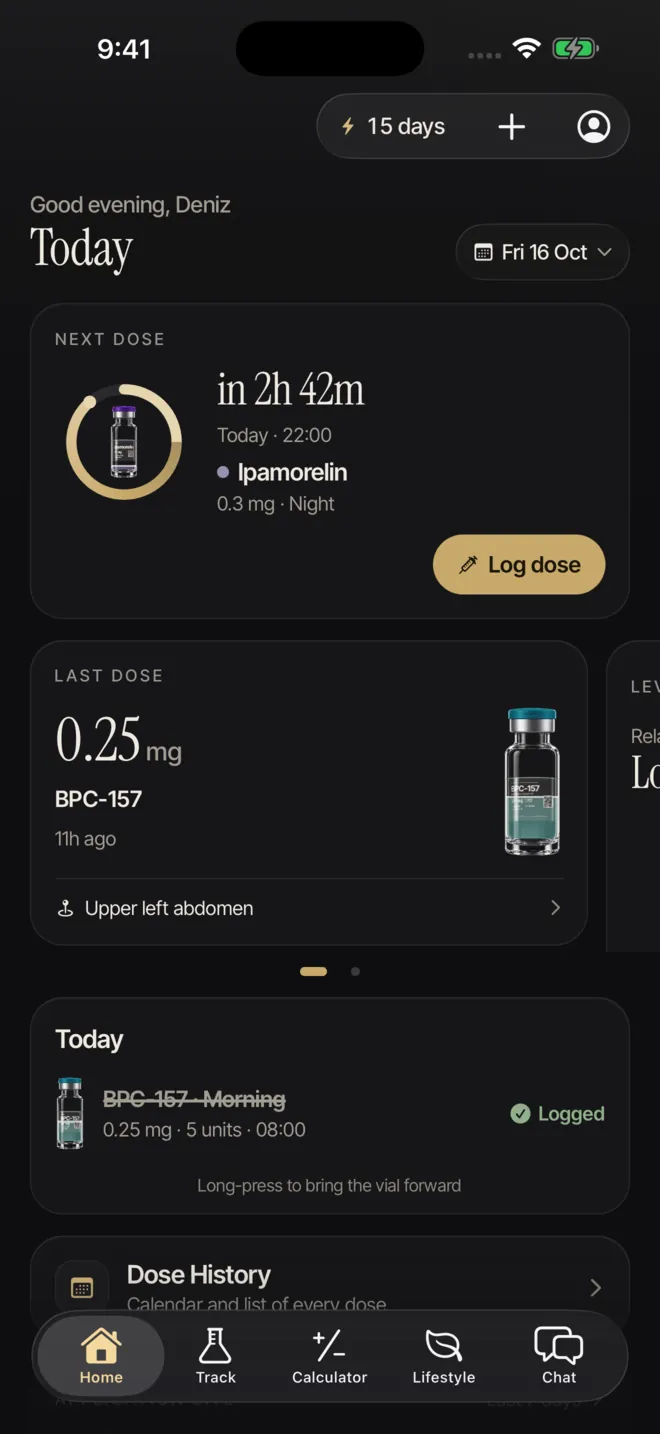
The Today screen brings dose timing and the last log together.