What is the same
Both labels are for adults with type 2 diabetes alongside diet and exercise, both cover lowering the risk of major cardiovascular events in those at high risk, and both carry a boxed warning about thyroid C-cell tumors [1][2].
What differs
- Active ingredient: semaglutide (GLP-1 receptor agonist) versus tirzepatide (GIP and GLP-1 receptor agonist).
- Form and rhythm: a tablet every morning on an empty stomach with up to 4 oz (about 120 mL) of plain water, at least 30 minutes before food, drinks or other oral medicines (Rybelsus®); an injection once a week at any time of day (Mounjaro®) [1][2].
- Age: Mounjaro® is labelled for children 10 and older with type 2 diabetes; the Rybelsus® label is for adults [2][1].
- Storage: Rybelsus® stays at room temperature in the original bottle; Mounjaro® is refrigerated, with single-dose pens and vials allowed up to 21 days unrefrigerated [1][2].
- Birth-control pills: the US Mounjaro® label points pill users to a contraceptive that is not swallowed, or to a barrier such as a condom on top of the pill, for four weeks after starting and after every step up [2]. The EU Mounjaro® label sees no need to change the pill [4].
Why the milligrams cannot be compared
Rybelsus® and Mounjaro® contain different molecules, so their milligrams are on different scales. On top of that, the Rybelsus® label reports that only about 0.4% to 1% of a tablet dose reaches the bloodstream [1]. Neither label converts a dose of one into a dose of the other.
Side by side, from the labels
| Label item | Rybelsus® (tablet) | Mounjaro® |
|---|---|---|
| Active ingredient | Semaglutide, a GLP-1 receptor agonist, by mouth | Tirzepatide, a GIP and GLP-1 receptor agonist |
| Maker | Novo Nordisk | Eli Lilly and Company |
| FDA-approved uses | Adults with type 2 diabetes: blood sugar control alongside diet and exercise, and lowering the risk of major cardiovascular events in those at high risk. [1] | Blood sugar control in adults and children 10 and older with type 2 diabetes, alongside diet and exercise; lowering the risk of major cardiovascular events in adults with type 2 diabetes who are at high risk. [2] |
| How it is taken | Once a day by mouth, in the morning on an empty stomach with up to 4 oz (about 120 mL) of plain water, swallowed whole; at least 30 minutes before food, drinks or other oral medicines. | Once a week, under the skin of the abdomen or thigh, or the back of the upper arm, at any time of day. |
| Forms in the US | Tablets in three strengths (section 3). In the US the same label covers Ozempic® tablets, a newer formulation; the label says the two are not substitutable milligram for milligram. | Single-dose pens, single-dose vials, multi-dose vials and the KwikPen® (four doses per pen) (section 3). |
| Dose steps | Section 2.2 of the label: a starting dose for the first 30 days that does not control blood sugar, then higher steps. Not repeated here; your prescriber sets your steps. [1] | Section 2.1 of the label: a low starting dose, raised in steps of at least 4 weeks if more blood sugar control is needed. Not repeated here; your prescriber sets your steps. [2] |
| Half-life (section 12.3) | About 1 week [1] | About 5 days [2] |
| Most common side effects (label) | Nausea, abdominal pain, diarrhea, decreased appetite, vomiting, constipation. | Nausea, diarrhea, decreased appetite, vomiting, constipation, indigestion, abdominal pain. |
| Storage (label) | Room temperature (20–25 °C), in the original bottle until use, to protect from moisture. | Refrigerated (2–8 °C). Single-dose pens and vials may be kept unrefrigerated up to 30 °C for a total of 21 days. Multi-dose vials and KwikPens® are discarded 30 days after first use or after 4 doses. |
| Boxed warning | Yes: risk of thyroid C-cell tumors. | Yes: risk of thyroid C-cell tumors. |
| In the EU (EMA) | Authorised since 2020. In the EU the newer tablets keep the Rybelsus® name; EMA issued a medication-error notice about the change. [3] | Authorised since 2022 for type 2 diabetes (age 10 and older) and for weight management in adults. Zepbound® is not a separate EU product. [4] |
Timing facts from the labels
| Label item | Rybelsus® (tablet) | Mounjaro® |
|---|---|---|
| Half-life (section 12.3) | About 1 week [1] | About 5 days [2] |
| Time to peak level (section 12.3) | About 1 hour after a tablet [1] | 8 to 72 hours after a dose [2] |
| Steady state (section 12.3) | After 4 to 5 weeks of daily tablets [1] | After 4 weeks of weekly doses [2] |
| After the last dose (section 12.3) | About 5 weeks in the circulation after the last tablet [1] | Not stated in the label [2] |
| Missed dose (section 2) | Skipped; the next tablet is taken the following day (section 2.1) [1] | Taken within 4 days (96 hours); after that, skipped (section 2.1) [2] |
| Section on switching | Section 2.3 (between Rybelsus® and Ozempic® tablets) and 2.4 (from Ozempic® injection to tablets) [1] | None [2] |
Moving between them, in either direction
Neither the Rybelsus® (tablet) label nor the Mounjaro® label sets out a schedule for moving from one to the other [1][2]. The timing facts above describe each medicine on its own; they are not a plan for a change. If a switch comes up, in whichever direction, the gap, the first dose of the new medicine and its steps are set by your prescriber.
Ozempic®, Wegovy®, Rybelsus®, Saxenda®, Victoza® and FlexTouch® are registered trademarks of Novo Nordisk A/S. Mounjaro®, Zepbound® and KwikPen® are registered trademarks owned or licensed by Eli Lilly and Company; Foundayo™ is a trademark of Eli Lilly and Company. PepLabo is not affiliated with or endorsed by these companies.
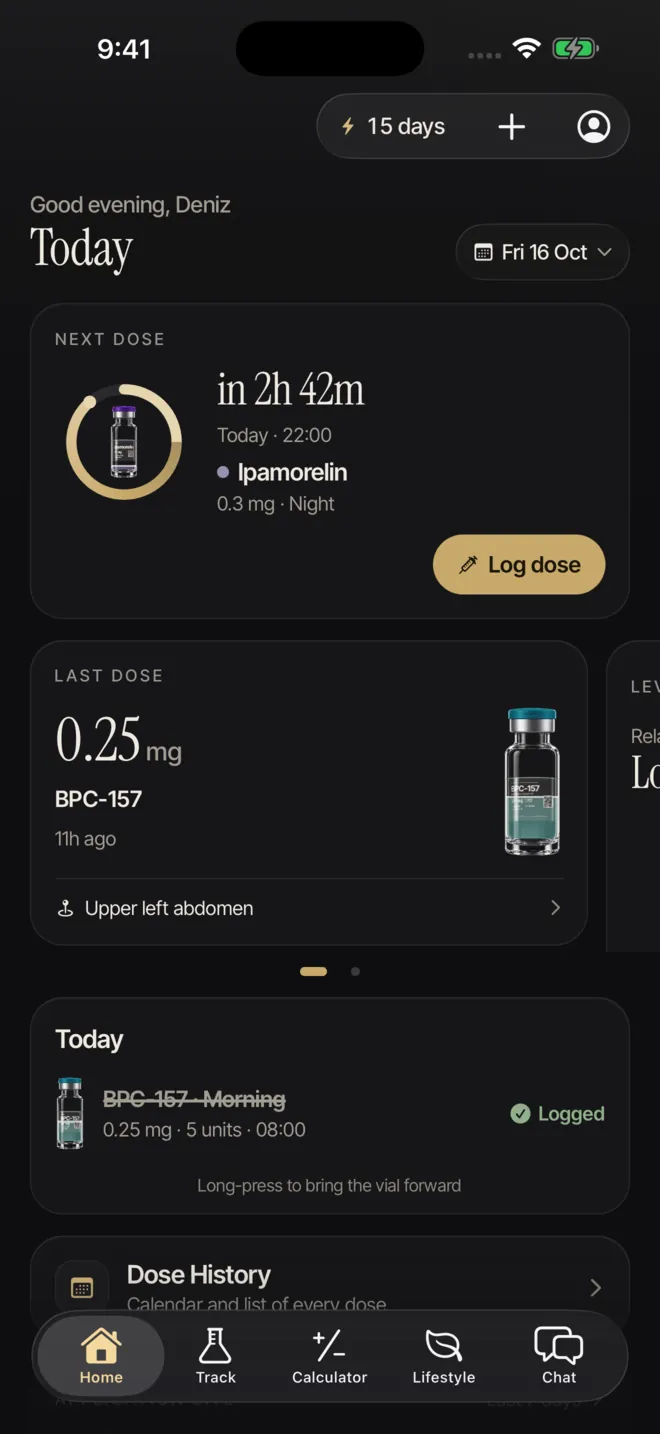 Open larger screen
The Today screen brings dose timing and the last log together.